






Arrowzoom Pro Acoustic Wood QRD Diffuser Panel – 25 Grid (KK1201)
Arrowzoom Pro Acoustic Wood QRD Diffuser Panel – 25 Grid (KK1201)
✅ Scatters mid/high reflections, keeps room alive
✅ Real published test data — STC 27, abs coef 1.06
✅ Solid lumber, 15.4 lb / 7 kg — not MDF
✅ 25-grid QRD geometry, screw-mount in 5 steps
Couldn't load pickup availability
-
Ordered
-
Shipped
- - -
At Your Doorstep

Tame flutter echo without killing the life in your room
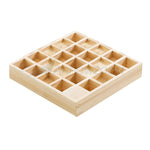
If you've ever clapped in your studio and heard that sharp, tinny ringing slap-back between the walls — that's flutter echo, and absorption alone won't fix it. Foam soaks up too much, leaves the room dead, kills the air around your vocals. A diffuser does the opposite job: it scatters mid and high-frequency reflections in 25 different directions, so the energy stays in the room but the echo doesn't. KK1201 is a QRD-style 25-grid wood diffuser, built from solid lumber (not MDF), 23.6" × 23.6" × 2.8" (60 × 60 × 7 cm), 15.4 lb (7 kg) of real wood, with a full published acoustic test report. Most diffusers won't show you the numbers. We will.
How it works — diffusion vs absorption
Pro studios mix both: absorbers on the front wall and first reflection points, diffusers on the rear wall and ceiling. KK1201 is the diffuser piece of that build.
Why a diffuser instead of more foam?
- Keeps the room alive. Drums, voice, acoustic instruments still sound like they're in a real space.
- Fixes flutter echo and slap-back between parallel walls — the #1 problem absorption can't solve.
- Improves stereo image and depth in mixing rooms by scattering rear-wall reflections.
- Reduces listener fatigue in long sessions — no dry, claustrophobic "anechoic" feeling.
Acoustic test data — the full curve
Most diffuser sellers won't show you a measurement. We tested KK1201 in an accredited acoustic chamber and publish the entire band. Here's the raw data — no curves shaved, no peak frequencies cherry-picked:
| Frequency | Transmission Loss (dB) | Absorption Coefficient |
|---|---|---|
| 125 Hz | 17 | 0.11 |
| 250 Hz | 17 | 0.24 |
| 500 Hz | 22 | 0.64 |
| 1,000 Hz | 27 | 1.06 |
| 2,000 Hz | 32 | 1.03 |
| 4,000 Hz | 38 | 1.00 |
| Overall | STC 27 | — |
Why solid lumber beats MDF
Specs
| Dimensions | 23.6" × 23.6" × 2.8" (60 × 60 × 7 cm) |
| Weight | 15.4 lb (7 kg) |
| Material | High-grade solid lumber wood (not MDF) |
| Pattern | 25-grid (5 × 5) QRD-style wells |
| Effective range | 500 Hz – 4,000 Hz (mid/high diffusion) |
| STC (overall) | 27 |
| Peak absorption | 1.06 @ 1 kHz |
| Mounting | Screw-mounted, hardware compatible |
| SKU | KK1201 |
What's in the box
- 1 × KK1201 Pro Acoustic 25-Grid Wood Diffuser Panel
- 23.6" × 23.6" × 2.8" / 60 × 60 × 7 cm · 15.4 lb / 7 kg
- Solid lumber, 25-grid QRD geometry
- Install guide (screws and wall anchors are common hardware, not included)
Install in 5 steps
- Pick the wall. For flutter echo: rear wall of your mixing position. For stereo image: side walls at first-reflection points.
- Mark four anchor points on the wall matching the back of the panel. Use a level — a crooked diffuser still works acoustically, but you will see it every day.
- Drill pilot holes, install wall anchors rated for at least 20 lb / 9 kg each (the panel is 15.4 lb, anchors give you safety margin).
- Drive screws through the panel's mounting points into the anchors. Snug, not crushing.
- Step back 8–10 ft and listen for the flutter to drop. If you want more scattering, add a second panel above or beside it.
Built for
Mount KK1201. If the flutter echo doesn't drop, if the panel arrives damaged, or if you decide the diffusion isn't right for your room — return inside 100 days, full refund. Backed by 35+ verified five-star reviews on this exact product and 300,000+ Arrowzoom customers worldwide.
Frequently asked
Click any question to expand ▼
Is this absorption or diffusion?
Diffusion, primarily. The 25-grid QRD geometry scatters mid/high reflections (500 Hz – 4 kHz) in 25 different directions instead of soaking them up. You'll see absorption coefficients above 1.0 in the test data because the panel also dissipates a portion of the energy as friction inside the wells — but the dominant behavior is scattering, not absorbing. Pair with foam or bass traps if you also need absorption.
How many panels do I need?
For a small home studio (under 150 sq ft / 14 m²): 2 panels on the rear wall is the highest-impact placement. For a control room or treatment room: 4 panels — rear wall pair plus ceiling pair. For a live room: 6+, distributed around the space. One panel will measurably reduce flutter; coverage scales the effect.
Will this soundproof my room?
No — and nothing this thin will. STC 27 is a measurement of how this panel handles sound that hits it; it does not mean your neighbors will stop hearing you. Soundproofing (transmission loss between rooms) requires mass, decoupling, and sealed gaps — usually mass-loaded vinyl, double drywall, and resilient channels. KK1201 is room treatment, not soundproofing.
How is this different from a $50 wood diffuser on Amazon?
Three things. (1) Material — KK1201 is real solid lumber, not MDF or veneered particle board. You can feel the 15.4 lb / 7 kg weight in your hands. (2) Geometry — the 25 wells are cut to QRD-derived depths, not just decorative. (3) Published test data. We measured this in an accredited chamber and publish the full frequency curve. Most cheap diffusers publish nothing because the numbers wouldn't justify the price.
What frequencies does it work on?
Effective scattering and absorption from 500 Hz to 4 kHz — voice, snare, vocals, guitar, cymbals, the range where flutter echo lives. Below 250 Hz the panel is mostly inert. If you have low-frequency room modes or boomy bass, you need bass traps (different product, different physics).
How heavy is it and how do I mount it safely?
15.4 lb / 7 kg. Use four wall anchors rated for at least 20 lb / 9 kg each for safety margin. Drywall anchors (toggle or self-drilling) work for most homes; into a stud is even better. The panel has mounting points on the back — drive screws through them into the anchors. Don't hang it on adhesive strips. This is real wood, not foam.
Does it come in different colors or finishes?
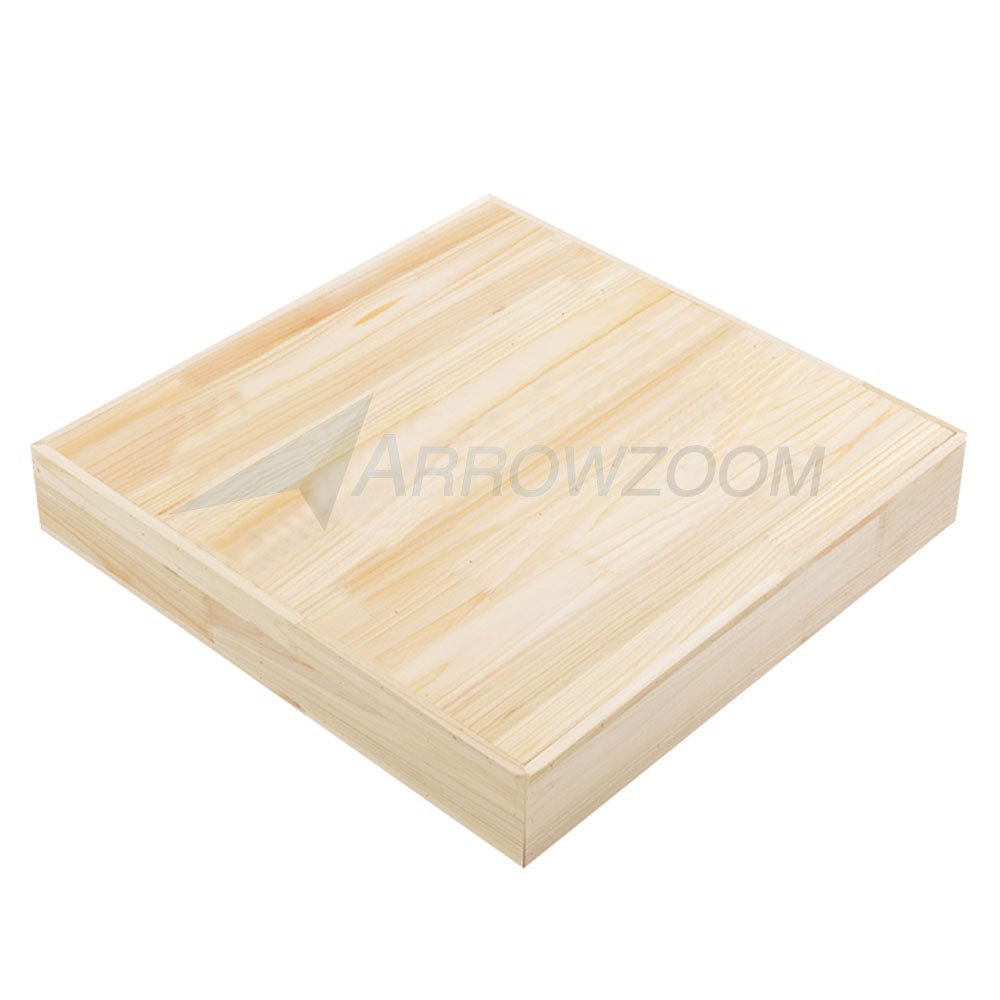
Natural lumber finish only, as shown. The wood can be refinished — sanded and stained — if you want to match a specific room aesthetic. We do not recommend painting it; paint fills the diffusion wells and dulls the scattering pattern.
Shipping & returns?
Handling time is 1–2 business days. Standard shipping is 7–14 days to the US and most countries (free worldwide on orders over $99). Express is 7 days or less. 100-day returns and replacement guarantee on every order. Ships from our nearest warehouse (US, EU, AU, Asia).
Shipping & Returns
Shipping & Returns
Purchase over $99USD or more to get FREE Shipping.
Normal Shipping
- 1-2 weeks in your hands
Express Shipping
- 1 week or less in your hands
Returns Policy
- We accept returns under specific conditions. Please follow these guidelines:
- How to Initiate a Return: Email service@arrowzoom.com with your name and order number.
- No Refunds for Buyer’s Remorse: Ensure your order details (design, size, address) are correct before purchasing.
- Cancellation Fee: Orders canceled (shipped or not) incur a 15% fee due to production costs.
Returned Parcels:
- Reshipping requires you to pay the shipping fee.
- For wrong items or quality issues, we refund the product value minus a 50% restocking fee.
- Shipping costs are non-refundable.
Return Conditions:
- Items must be in new, unaltered condition.
- Returns for mistaken shipments must be approved within 3 working days of receipt.
- Requests must be made within 2 weeks of shipping.
Note: No credit is given for items damaged during shipping. Contact the shipping company for compensation.


Soundproofing FAQs
Frequently Asked Questions
How do I soundproof my wall against noisy neighbours? 🤫
How do I soundproof my wall against noisy neighbours? 🤫
Soundproofing aims to prevent sound from entering or leaving a room, like blocking noise from those pesky neighbours. For more tips, check out our guide on soundproofing against noisy neighbours! 📖
How many Acoustic Panels Do I Need?
How many Acoustic Panels Do I Need?
The first step is going to be installing acoustic panels on your walls. These reduce the reverberations and echoes in the space.
Use our Free Tiles Calculator to find out
How do you install soundproofing? 🔧
How do you install soundproofing? 🔧
There are two main options for installing our DIY soundproofing solutions, and we're here to support you every step of the way!
DIY Installation:
All of our systems are DIY-friendly, saving you on installation costs.
80% of customers install the systems themselves because we’ve made it easy!
We provide simple, step-by-step installation guides and videos for a hassle-free experience.
Our technical team is ready to answer any questions and offer support. We're here for you! 🤗
Use a Local Contractor:
You're on your way to a noise-free home! If DIY isn’t an option, consider hiring a local tradesperson.
We simplify the process by communicating directly with your tradesperson throughout the installation.
Visit our installation page for more details! 📞
What's the difference between impact and airborne noise? 🔊
What's the difference between impact and airborne noise? 🔊
1. Airborne Noise
- This travels through the air, like conversations, TV sounds, or barking dogs. When sound waves hit a building, they cause it to vibrate, transmitting through the structure.
2. Impact Noise
- This results from physical impacts on buildings, such as footsteps, slamming doors, or moving furniture. Impact noise can be harder to isolate, as these vibrations are stronger and travel further through dense materials.
What are decibels? 📏
What are decibels? 📏
Decibels are measured logarithmically (not as a percentage) . This means that every increase of 10dB on the scale is a tenfold increase in sound pressure level (SPL) . Near silence is 0dB 🤫, while a sound at 10dB is ten times louder!
- 30-40 dB = Soft music, whisper 🎶
- 60-80 dB = Office noise, traffic 🚗
- 85-100 dB (HARMFUL) = Subway, shouted convo, chainsaw ⚠️
- 100-140 dB (DANGEROUS) = Chainsaw, loud concert, racing, shooting range 🚨
Is everything in stock and ready to ship? 📦
Is everything in stock and ready to ship? 📦
In stock, ships in 1-2 business days! Learn More
Where Is My Order?
Where Is My Order?
Track your order: Check your email or visit our Tracking Page.
FREE & FAST GLOBAL SHIPPING 🚚
30 DAYS RETURNS ✅
24/7 Live Support 📞
FREE & FAST GLOBAL SHIPPING 🚚
30 DAYS RETURNS ✅
24/7 Live Support 📞
FREE & FAST GLOBAL SHIPPING 🚚
30 DAYS RETURNS ✅
24/7 Live Support 📞
FREE & FAST GLOBAL SHIPPING 🚚
30 DAYS RETURNS ✅
24/7 Live Support 📞
FREE & FAST GLOBAL SHIPPING 🚚
30 DAYS RETURNS ✅
24/7 Live Support 📞
FREE & FAST GLOBAL SHIPPING 🚚
30 DAYS RETURNS ✅
24/7 Live Support 📞
FREE & FAST GLOBAL SHIPPING 🚚
30 DAYS RETURNS ✅
24/7 Live Support 📞
FREE & FAST GLOBAL SHIPPING 🚚
30 DAYS RETURNS ✅
24/7 Live Support 📞
FREE & FAST GLOBAL SHIPPING 🚚
30 DAYS RETURNS ✅
24/7 Live Support 📞
FREE & FAST GLOBAL SHIPPING 🚚
30 DAYS RETURNS ✅
24/7 Live Support 📞
FREE & FAST GLOBAL SHIPPING 🚚
30 DAYS RETURNS ✅
24/7 Live Support 📞
FREE & FAST GLOBAL SHIPPING 🚚
30 DAYS RETURNS ✅
24/7 Live Support 📞


